The Upgrade Tree and How Much Grinding It Takes
Last reviewed: 12 September 2026 · Newest game update reflected: 2026.08.18.12.05 (18 August 2026). The median player finishes at around 8 hours. That figure comes from the 600 most recent English reviews that carry playtime data, and the distribution is unusually tight: 65% of them fall between 5 and 10 hours.
| Playtime | Share of sample |
|---|---|
| Under 2 hours | 3% |
| 2 to 5 hours | 7% |
| 5 to 10 hours | 65% |
| 10 to 20 hours | 22% |
| Over 20 hours | 2% |
Quartiles from the same sample: 6.5 hours at P25, 8.0 at the median, 9.9 at P75, 13.3 at P90.
That is the honest answer to "how long is the grind" — and it is short enough that most complaints about grinding are really complaints about pacing within those 8 hours, not about total length.
How the economy actually works
Mumpitz Games describes it plainly on the store page: resources are earned from every run, won or lost, and spent on a "massive upgrade tree" that unlocks and upgrades turrets.
The design consequence matters more than it sounds. There is no fail state that costs you progress. A wipe on a hard stage still pays. This means the game is never blocked — only slow — and that changes what "stuck" means. If you cannot clear a stage, you are under-upgraded rather than under-skilled, and the fix is mechanical.
Where the grind complaints come from
Reviews that criticise the pacing are consistent about the shape of it. One player with 8.6 hours describes the loop as "a lot of redoing certain levels just to grind enough points to upgrade certain abilities, no changing in between levels, just grinding for points."
Two things are being reported there, and only one is about length.
The repetition is undirected. You replay a stage you have already solved, and nothing about it changes. The resources accumulate, but the play does not develop.
There is no mid-run adjustment. You commit to a layout, and the run resolves. That is a design choice rather than a flaw, but it means a failed run teaches less than it would in a roguelite where you adapt as you go.
Another reviewer with 8.3 hours frames the same feeling in value terms: "the core gameplay is fun and unique but it lacks depth… it feels more like a 4-5€ game. For 10€ it just does not have enough content." At $8.99 that is a reasonable disagreement to have, and it is worth knowing before you buy.
Grinding efficiently
Since resources come from every run regardless of outcome, the only variable you control is resources per minute.
Replay a stage you clear comfortably, not the one blocking you. A stage you fail slowly pays less per minute than one you clear quickly. This is the single biggest lever.
Buy scaling before buying magnitude. The laser and grenade branches change how a defence scales; another cannon tier just adds a number. If you are stuck at a wall like 3.2, the branch matters more than the tier.
Do not chase the buy-all achievement early. Only 17.3% of players have purchased every upgrade, and it is the one achievement that cannot be shortened by playing better. Let it accumulate underneath everything else.
On save editing
A community guide by the player Erèbes documents how to locate and edit the save file to add resources or duplicate turrets, and it is upfront that this is for single-player experimentation after finishing the game once.
We are noting that it exists because it tells you something about the pacing — enough people found the mid-game curve slow that someone wrote the guide. We are not reproducing the method. Editing raw save data can corrupt a save, and the guide's own first instruction is to back up before touching anything.
What the upgrade screen actually shows
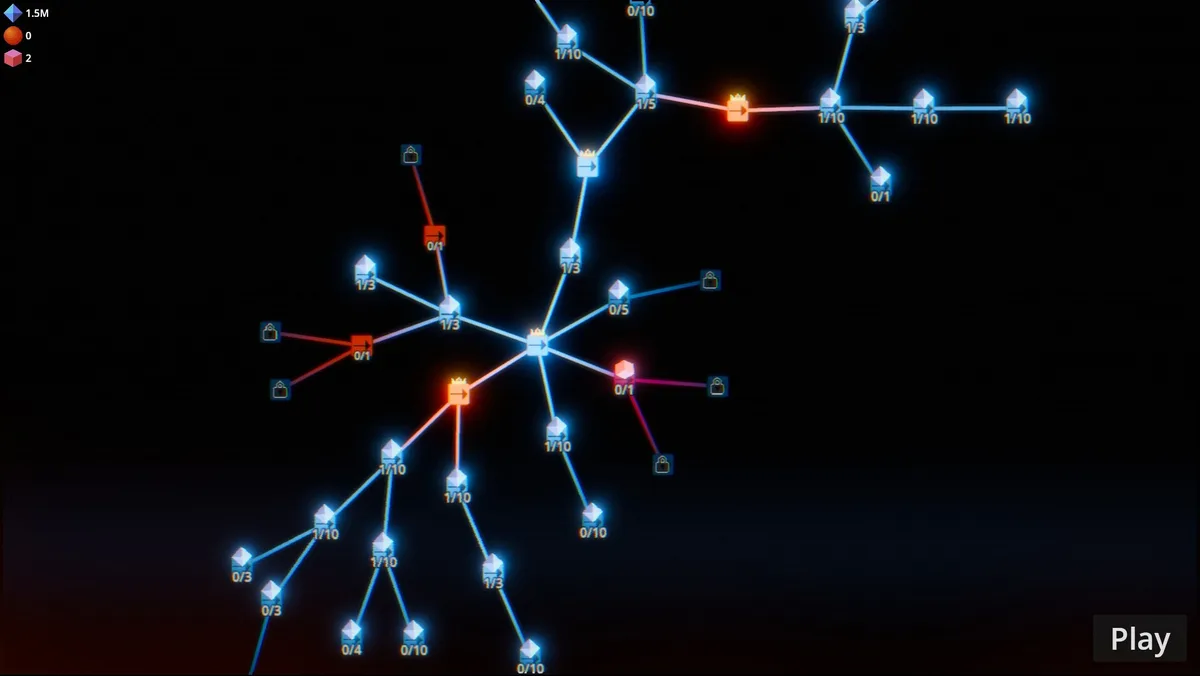
The tree is a branching node graph rather than a list. Nodes carry their own tier counters — the official screenshot shows entries at 1/5, 2/10, 0/10 and 1/4 sitting side by side, so different branches have different depths rather than a uniform ten tiers each.
Three separate resource types are tracked in the corner of that screen, which means a branch can be gated on a currency you are not currently earning much of. That is worth knowing before you commit to a plan: "grind more" is not always the answer if the blocker is the wrong currency.
The save file names all three, which is the clearest confirmation of what each one is for. UPGRADE_MARKS are the blue crystals — the bulk currency, earned every run. LEVEL_FINISHED are the red spheres, one per stage you finish. ALL_KILLED_CHALLENGE are the pink cubes, one per stage where you kill everything. The second and third are capped by how many stages exist, not by how long you grind, which is exactly why a branch gated on them cannot be rushed.
What the whole tree costs
Erèbes' save-editing guide states a figure for the entire tree: 2,894,436 blue crystals, 6 red spheres and 12 pink cubes. That is one player's reading of their own save at one patch, not a developer statement, so treat the crystal number as an order of magnitude rather than a target — but the two small numbers are informative on their own. Six red spheres and twelve pink cubes means every stage finished and every stage cleared with a full kill, and there is no way to farm past that. If you want the buy-all-upgrades achievement, the achievement side of it is a checklist, not a grind.
Individual nodes carry the game's own one-line descriptions. The Cannon's reads: low fire rate but high damage, projectiles penetrate through multiple orcs. Those descriptions are the most reliable turret information in the game, because they come from the build rather than from a player's measurements.
What we have not documented
We do not have per-node upgrade costs, tier counts, or the resource yield of any specific stage. None of that is published by Mumpitz Games or measured in a source we can verify, so we cannot tell you how many replays a given branch takes. The playtime figures above describe how long people played, not how much of that was grinding.
- Steam appdetails for appid 4594150 — official description of the upgrade tree and resource economy
- Steam review corpus, 600 most recent English reviews with playtime_forever, retrieved 11 Aug 2026 — playtime distribution computed from that sample
- Steam ISteamUserStats/GetGlobalAchievementPercentagesForApp for appid 4594150, retrieved 11 Aug 2026 — buy-all-upgrades at 17.3%
- Steam community guide 'Resource Editing & Tower Duplication' by Erèbes, 30 July 2026 (https://steamcommunity.com/sharedfiles/filedetails/?id=3774341549)